

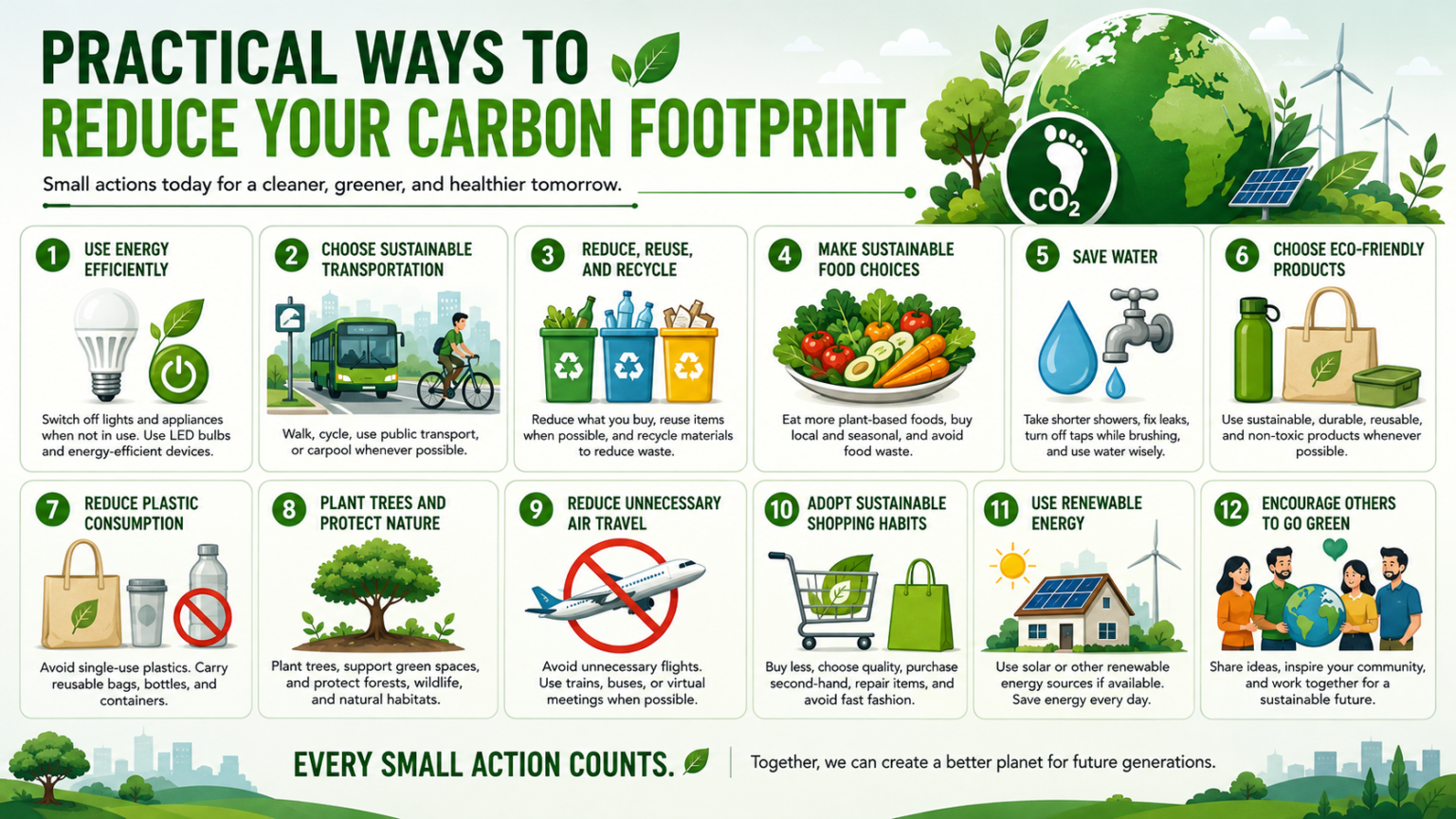
Climate change is one of the most important environmental challenges facing the world today. Everyday activities such as driving, using electricity, buying products, and producing household waste contribute to greenhouse gas emissions. These emissions increase the amount of heat trapped in the atmosphere and contribute to global warming.
Although governments and large businesses have an important role to play in protecting the environment, individual choices also matter. Making small, practical changes to daily habits can help reduce your carbon footprint while supporting a cleaner and more sustainable future.
In this guide, we explore practical ways to reduce your carbon footprint without making everyday life unnecessarily complicated.
What Is a Carbon Footprint?
A carbon footprint refers to the total amount of greenhouse gases produced directly or indirectly by an individual, household, organization, or activity. It is commonly measured in carbon dioxide equivalents (CO₂e), which account for different greenhouse gases according to their warming effects.
Your personal carbon footprint may include emissions from transportation, electricity consumption, heating and cooling, food choices, shopping habits, and waste disposal.
Understanding where these emissions come from is the first step toward reducing them.
1. Use Energy More Efficiently at Home
Household energy consumption is an important source of carbon emissions, particularly when electricity comes from fossil fuels. Improving energy efficiency can reduce environmental impact and help lower utility bills.
Switch off lights, fans, televisions, and other appliances when they are not needed. Replace traditional bulbs with energy-efficient LED lighting, which generally uses less electricity and lasts longer.
Choose energy-efficient appliances when replacing old equipment. Refrigerators, air conditioners, washing machines, and other household devices can consume significant amounts of electricity, so comparing their energy performance before purchasing can make a difference.
You can also reduce unnecessary air conditioning by using natural ventilation when weather conditions allow, closing curtains during particularly hot periods, and maintaining appliances regularly.
2. Choose More Sustainable Transportation
Transportation is another major contributor to greenhouse gas emissions. Cars, motorcycles, buses, trucks, and airplanes rely heavily on fossil fuels in many parts of the world.
Walking or cycling for short journeys can reduce emissions while supporting physical activity. Public transportation is another useful option because buses and trains can carry many passengers at once.
When driving is necessary, combine errands into one trip, maintain appropriate tyre pressure, avoid unnecessary idling, and keep your vehicle properly serviced. Carpooling with colleagues, friends, or family members can also reduce the number of vehicles needed for regular journeys.
For people considering a new vehicle, an electric or fuel-efficient model may help reduce emissions, depending on how its electricity or fuel is produced.
3. Reduce Food Waste
Food waste has environmental consequences throughout the food supply chain. Growing, processing, packaging, transporting, and storing food all require resources and energy. When food ends up in landfills, it can also produce methane as it decomposes.
Planning meals before shopping is a simple way to avoid buying more food than necessary. Check what you already have at home, prepare a shopping list, and store ingredients correctly to extend their freshness.
Use leftovers creatively rather than throwing them away. Freezing suitable foods, sharing extra meals, and understanding food date labels can also help reduce unnecessary waste.
Where facilities are available, composting fruit and vegetable scraps can turn organic waste into useful material for gardens and plants.
4. Eat More Plant-Based Meals
Food production contributes to greenhouse gas emissions, and different foods have different environmental impacts. Meat and dairy production, particularly from ruminant animals such as cattle and sheep, can generate significant emissions.
You do not necessarily need to become vegetarian or vegan to make a difference. Start by including more plant-based meals in your weekly routine.
Beans, lentils, chickpeas, vegetables, fruits, nuts, and whole grains can provide a variety of nutrients while helping diversify your diet. Replacing some meat-based meals with plant-based alternatives is a practical step toward a more sustainable eating pattern.
Choosing seasonal and locally produced foods where practical can also reduce certain transportation and storage impacts, although production methods are important too.
5. Reduce Single-Use Plastics
Plastic products are made using fossil-fuel-based materials, and their production, transportation, and disposal can contribute to environmental pollution and emissions.
Reusable alternatives can help reduce the need for disposable products. Carry a reusable shopping bag, use a refillable water bottle, and choose durable food containers instead of repeatedly purchasing disposable ones.
Avoid unnecessary packaging when possible and select products with recyclable or minimal packaging. However, remember that recycling systems differ by location, so check which materials your local collection service actually accepts.
Reducing consumption in the first place is often more effective than relying entirely on recycling.
6. Buy Less and Choose Durable Products
Every product requires resources to manufacture, package, and transport. Frequently replacing clothes, electronics, furniture, and household items can increase your overall environmental impact.
Before purchasing something, consider whether you genuinely need it. Choosing durable products that can be repaired and used for longer periods can reduce the demand for new materials.
Second-hand shopping, clothing exchanges, borrowing, and repairing damaged items are also practical alternatives to buying new products.
When shopping for electronics, look for products that can be upgraded or repaired rather than replaced completely when a minor component stops working.
7. Save Water and Reduce Energy Use
Water conservation is another useful part of sustainable living. Treating, pumping, and heating water require energy, meaning unnecessary water consumption can indirectly increase greenhouse gas emissions.
Fix leaking taps and pipes, avoid leaving water running while brushing your teeth, and use washing machines only when you have a suitable full load.
Taking shorter showers and using water-efficient fixtures can also help. If you use heated water, reducing unnecessary hot-water consumption may provide additional energy savings.
Collecting rainwater for suitable outdoor uses can be helpful where local conditions and regulations permit.
8. Make Your Garden and Outdoor Space Greener
Plants absorb carbon dioxide as they grow, while trees can provide shade, support biodiversity, and improve local environments.
Planting suitable trees, maintaining a small garden, or growing vegetables at home can encourage a closer connection with nature. Native plants are often a good choice because they are adapted to local conditions and may require less maintenance.
Avoid wasting water on gardens and use compost where appropriate. If you have outdoor space, consider planting flowers that provide food and shelter for local pollinators.
Planting trees is valuable, but it should complement—not replace—efforts to reduce fossil-fuel emissions.
9. Use Renewable Energy Where Possible
Renewable energy sources such as solar, wind, and hydropower can generate electricity with much lower operational greenhouse gas emissions than fossil-fuel power stations.
If you own a home, investigate whether rooftop solar panels are suitable for your property. Consider installation costs, available sunlight, equipment quality, maintenance, and local electricity regulations before making a decision.
If installing renewable energy equipment is not practical, look for legitimate renewable electricity options offered by your energy provider where available.
Improving energy efficiency remains important, even when renewable energy is used.
10. Reduce the Environmental Impact of Digital Habits
Digital activities also require energy. Data centres, internet networks, personal computers, smartphones, and other connected devices depend on electricity.
You can reduce unnecessary energy consumption by switching off devices when they are not in use, enabling power-saving settings, and avoiding excessive standby consumption.
Keep electronics for longer instead of upgrading them simply because a newer model is available. Repairing or responsibly recycling old devices can also reduce electronic waste.
Deleting unnecessary files is not a major personal climate solution on its own, but using digital services thoughtfully and reducing unnecessary device replacement can support more sustainable habits.
11. Choose More Sustainable Clothing
The clothing industry uses raw materials, water, energy, and transportation throughout the manufacturing process. Fast fashion can increase environmental pressure because garments are often purchased, worn briefly, and discarded.
Choose clothing that is comfortable, durable, and suitable for repeated use. Repair small damages, donate wearable items, and consider second-hand clothing when appropriate.
Washing clothes only when necessary, using suitable lower-temperature settings, and air-drying when possible can also reduce energy consumption.
The most sustainable clothing choice is often to make better use of what you already own.
12. Encourage Sustainable Habits in Your Community
Individual actions become more effective when communities and organizations support them. Sharing practical environmental knowledge can encourage others to make responsible choices.
You can participate in local clean-up activities, support tree-planting projects, encourage waste separation, and promote responsible water and energy use.
Schools, workplaces, community groups, and local businesses can also introduce recycling facilities, reduce disposable products, and improve energy efficiency.
Supporting environmental policies and businesses that take measurable action can help create wider improvements beyond individual households.
How to Start Reducing Your Carbon Footprint
Changing every habit at once can feel overwhelming. A more effective approach is to begin with a few realistic changes and build on them over time.
Start by identifying activities that contribute most to your personal emissions. For some households, transportation and electricity may be the largest sources. For others, food choices, heating, or frequent shopping may have a greater impact.
Choose two or three changes that fit your lifestyle. For example, you might begin using public transport more often, reducing food waste, and switching off unused electrical equipment.
Review your progress regularly and focus on changes that are practical and sustainable over the long term. Consistent improvements are generally more useful than making dramatic changes that are difficult to maintain.
Conclusion
Reducing your carbon footprint does not require completely changing your lifestyle. Simple actions such as saving electricity, using sustainable transportation, reducing food waste, eating more plant-based meals, avoiding unnecessary purchases, and conserving water can all contribute to a lower environmental impact.
The most important step is to understand how everyday decisions affect the environment and make improvements wherever practical. When individuals, families, communities, and businesses work toward the same goal, their combined efforts can support a healthier planet and a more sustainable future.
Frequently Asked Questions (FAQs)
1. What is the easiest way to reduce your carbon footprint?
Start with simple habits such as switching off unused electrical appliances, walking for short journeys, reducing food waste, carrying reusable shopping bags, and buying only what you need.
2. Does using less electricity help the environment?
Yes. Reducing electricity consumption can lower greenhouse gas emissions, particularly in areas where electricity is generated using coal, oil, or natural gas. It can also reduce household energy costs.
3. How does food affect your carbon footprint?
Food production, processing, packaging, transportation, and disposal all create emissions. Reducing food waste and including more plant-based meals can help lower the environmental impact of your diet.
4. Can recycling reduce my carbon footprint?
Recycling can reduce the need for new raw materials and the energy required to manufacture certain products. However, reducing unnecessary consumption and reusing items are also important.
5. Are electric vehicles better for the environment?
Electric vehicles generally have lower lifetime greenhouse gas emissions than comparable petrol or diesel vehicles, although the overall impact depends on electricity generation, battery production, vehicle efficiency, and how long the vehicle is used.
6. How can families reduce their carbon footprint?
Families can save energy, plan meals, reduce food waste, use reusable products, share transportation, conserve water, and teach children responsible environmental habits.
7. Do small individual actions really make a difference?
Yes. Individual actions can reduce personal emissions and encourage wider changes in households and communities. Their impact becomes more meaningful when supported by businesses, governments, and effective environmental policies.
8. How can I measure my carbon footprint?
You can use an online carbon footprint calculator to estimate emissions from your home energy use, transportation, diet, and purchasing habits. The result is an estimate, so its accuracy depends on the information and assumptions used.